
And I mean fans in the fangirl/fangent/otakuish sense. Hmm. I just realized something. I used "fangent" to mean a tangent indulged in by fans (a more random and less canonical relative of the fan theory) but when paired with fangirl, it could also be a gentleman who is a fan. This all makes me very happy.
BUT!
Not as happy as this web comic, which I stumbled across by way of Twitter (because random steampunk tidbits soothe my fevered brow better than actual sleep {my brow is fevered because I recently became a computer teacher, while keeping my part-time job at Barnes and Noble.})
It reminds me in a way of Five Fists of Science, but, dare I say(?) better. I feel that there should be a question mark in the previous sentence, so I put one in. And I do dare say it, because FFoS is pretty entertaining, but kind of meh. Any hoo, "The Thrilling Adventures of Lovelace and Babbage" is about Charles Babbage, creator of the first computer, and Ada Lovelace, creator of the first computer program. Apparently they fight crime? It's fantastic.
Even more fantastic (but actually less fantastic inasmuch as it's actually true) are all the links to Primary Source Documents by about the protagonists. I dare not start clicking on any more of them tonight or I really won't get any sleep. And then I won't be able to set up the computers for next week's classes. Maybe I should give the middle school kids a project later to research the history of computers on the interwebz. Whoever can go back the farthest gets a prize.
Of course, depending on how broadly one defines computers, there were even earlier examples of machines that used basic logic, but not to do math. So, since a computer ought to compute, the Difference Engine was the first one.
Showing posts with label art. Show all posts
Showing posts with label art. Show all posts
Friday, August 17, 2012


Thursday, April 19, 2012
Monuments and Poetry
Mischievous, laughing boys, who grewTo quick manhood to be 'The Few'Who flew above all human callThrough Summer's height to Autumn's fall,Infring'd the sanctity of spaceIn freedom's name-and died in grace;Falling like leaves upon the WealdTo russet-spot on English field,Their brief, gay, valiant season spentFor us. Our task, their monument,Nature herself has taken o'erAnd has decreed for evermore,'The Few' shall be remembered byWhite chalk marks in a summer sky
That's one of my favorite poems. It's about the Battle of Britain but I don't know who wrote it. Nature may provide a fitting monument with vapor trails, but people have also built an amazing memorial to the battle. It's in London. I actually saw this at night, but it was not lit up and I didn't know what it was - just some walls with bronze statues. I wish I had seen the whole thing:


The story about is happening in each panel is awesome too. Monuments should be representational and realistic. It tells the story better, and the story is what people remember.
Here's another good poem:
High FlightOh! I have slipped the surly bonds of earthAnd danced the skies on laughter-silvered wings;Sunward I've climbed, and joined the tumbling mirthOf sun-split clouds - and done a hundred thingsYou have not dreamed of - wheeled and soared and swungHigh in the sunlit silence. Hov'ring thereI've chased the shouting wind along, and flungMy eager craft through footless halls of air.Up, up the long delirious, burning blue,I've topped the windswept heights with easy graceWhere never lark, or even eagle flew -And, while with silent lifting mind I've trodThe high untresspassed sanctity of space,Put out my hand and touched the face of God.Pilot Officer Gillespie MageeNo 412 squadron, RCAFKilled 11 December 1941
He wrote that after flying a Spitfire for the first time. Awesome, huh? Here's a whole bunch of poems about flying.
I like this one:
An airman is always quite free, sir.
To land with a bump or a greaser.
Any old clunk,
can land with a thump,
But pro's go for smoothie crowd pleasers.
— Anon.
And this one:
The Co-pilot By Keith Murray (Capt Colonial Airlines). Written in 1941 and first published in October 1942 in "The Airline Pilot" the monthly magazine of US ALPA.I am the co-pilot, I sit on the right,It’s up to me to be quick and bright;I never talk back for I have regrets,But I have to remember what the Captain forgets.I make out the flight plan and study the weather,Pull up the gear, stand by to feather;Make out the mail forms and do the reporting;And fly the old crate while the Captain is courting.I take the readings, adjust the power,Put on the heaters when we’re in a shower;Tell him where we are on the darkest of night,And do all the bookwork without any light.I call for my Captain and buy him cokes;I always laugh at his corney jokes;And once in a while when his landings are rusty,I always come through with, "By gosh it’s gusty".All in all I’m a general stooge,As I sit on the right of the man I call "Scrooge";I guess you think this is past understanding,But maybe some day he will give me a landing.
I have an mp3 of a different version that I think flows a little better, but this apparently is the original.
Wednesday, April 18, 2012
Diesel Punk. Meh.
I really don't know how I feel about diesel punk. I suppose all on it's own I like it. It's the future that steampunk becomes, followed by raygun gothic. I love the Rocketeer, and Tale Spin. I love heavier-than-air flying machines as much or more than aerostats. But something about it leaves me cold.
I think there are two things about it. The first one is that's it's 20th Century. Sometimes steampunk depresses me a little, because those people in their shiny goggles and lovely clothes and expressions of wonderment are going to have to get to the 20th Century eventually, with its WWI, and its International Style architecture. The 70s happen.... I'm not a fan of alternate history, so there's no help for it.
Still, I find WWI fascinating, and not just because of the aviators. Scott Westerfeld's Leviathan series is a really cool fictionalization/steam/dieselpunkification of it. It has a bunch of the bad stuff in it, but it still retains a sense of worth-whileness and optimism and honor that most WWI stories don't manage. It was a human endeavor, fought with new machines and on a huge scale (although, honestly, hasn't anyone ever heard of the Seven-Years-War? That was really the first World War). Poetry came out of WWI.
Then there were the 20s and 30s. The golden age of aviation, an amazing era of exploration and prosperity (well, the 20s) and just a pretty cool time in general, unless you lived in the Weimar Republic... Strangely, there's not a lot of diesel punk in this era (Talespin and Rocketeer being notable exceptions, although the Rocketeer edges into WWII)
Freaking WWII. Now, I also, find WWII terribly interesting, but overdone. The History Channel, back when they showed history programs, knew of no other wars, and neither do game designers. Or diesel punk fans. My other problem with diesel punk is the fans. They are far more nitpicky than your typical steampunk, going on and on about this and that uniform and tank and gun and whatever. That's all well and good (I will geek out about military hardware all day long) but they ought to be nice about it, like steampunks. Where a steampunk will say "Ooh! What's that? That's awesome! Did you make it up? It's REAL? To wikipedia!" a diesel punk will be more like "They didn't have that yet."

That's the whole point of whatever punk! You cram cool shiny things together and try to figure out how they would work. It's supposed to be fun.
With some very well-done exceptions (most of which are not WWII settings), it seems like a lot of diesel punk is just WWII with more metal, a darker setting O_O and less human spirit. Where steampunk magnifies the heroic and creative person in an era that stood a chance of overshadowing people, diesel punk grinds and mechanizes the individual, rather than telling their stories.
It's all this:

and none of this.
No climbing Pointe du Hoc, no Audie Murphy, no Battle of Britain. Just CG models of extra big tanks, guys in gas masks, and hot SS dominatrices. Now, I know the SS had the snazziest uniforms in the war, and we all know how I feel about jodhpurs, but come on! Poetry came out of WWII too, but I'll save that for later.
Here's the example of nitpicking that prompted this post, a comment on my Talespin AMV, which I had described offhandedly as "baby's first steampunk". The comment was this (caps in the original):
While we're over analyzing a cartoon, I might point out that Don Karnage's airship is like the one in Master of the World, which is Jules Verne. At 0:18 in the video you can see the steam engines on the side propellers, and they never specify what powers the upward-pointing rotors. I always figured it was either a later edition he added using piston engines, or else they run off the steam engines too, either using an electric turbine, or a simple belt drive. In the show, the Iron Vulture doesn't even make a typical airship noise (droning propellers) but rather the chugging of a steam engine. Many of his crew also wear older clothes - top hats, for example. He's a bit of a throwback in the setting of the story. The awesome level of detail Disney put into the show means you actually can tell how the tech works, and the pirates, at least, are still a little steampunk.
Is that the point of my video? No. the point is that Talespin is awesome, and Abney Park is awesome.
I think there are two things about it. The first one is that's it's 20th Century. Sometimes steampunk depresses me a little, because those people in their shiny goggles and lovely clothes and expressions of wonderment are going to have to get to the 20th Century eventually, with its WWI, and its International Style architecture. The 70s happen.... I'm not a fan of alternate history, so there's no help for it.
Still, I find WWI fascinating, and not just because of the aviators. Scott Westerfeld's Leviathan series is a really cool fictionalization/steam/dieselpunkification of it. It has a bunch of the bad stuff in it, but it still retains a sense of worth-whileness and optimism and honor that most WWI stories don't manage. It was a human endeavor, fought with new machines and on a huge scale (although, honestly, hasn't anyone ever heard of the Seven-Years-War? That was really the first World War). Poetry came out of WWI.
Then there were the 20s and 30s. The golden age of aviation, an amazing era of exploration and prosperity (well, the 20s) and just a pretty cool time in general, unless you lived in the Weimar Republic... Strangely, there's not a lot of diesel punk in this era (Talespin and Rocketeer being notable exceptions, although the Rocketeer edges into WWII)
Freaking WWII. Now, I also, find WWII terribly interesting, but overdone. The History Channel, back when they showed history programs, knew of no other wars, and neither do game designers. Or diesel punk fans. My other problem with diesel punk is the fans. They are far more nitpicky than your typical steampunk, going on and on about this and that uniform and tank and gun and whatever. That's all well and good (I will geek out about military hardware all day long) but they ought to be nice about it, like steampunks. Where a steampunk will say "Ooh! What's that? That's awesome! Did you make it up? It's REAL? To wikipedia!" a diesel punk will be more like "They didn't have that yet."

That's the whole point of whatever punk! You cram cool shiny things together and try to figure out how they would work. It's supposed to be fun.
With some very well-done exceptions (most of which are not WWII settings), it seems like a lot of diesel punk is just WWII with more metal, a darker setting O_O and less human spirit. Where steampunk magnifies the heroic and creative person in an era that stood a chance of overshadowing people, diesel punk grinds and mechanizes the individual, rather than telling their stories.
It's all this:

and none of this.
No climbing Pointe du Hoc, no Audie Murphy, no Battle of Britain. Just CG models of extra big tanks, guys in gas masks, and hot SS dominatrices. Now, I know the SS had the snazziest uniforms in the war, and we all know how I feel about jodhpurs, but come on! Poetry came out of WWII too, but I'll save that for later.
Here's the example of nitpicking that prompted this post, a comment on my Talespin AMV, which I had described offhandedly as "baby's first steampunk". The comment was this (caps in the original):
Talespin is DIESEL PUNK as its defined using 30s era equivalent technology, clothing, and terminology. Most notable are Internal Combustion engines and Vacuum tube based electronic technology.Sure, technically that's true. But who cares? Apparently I do, since I was annoyed enough to write a whole post about it. Anyway, "baby's first diesel punk" doesn't sound as good, and is not as understandable to most people. Maybe that's why diesel punk fans have a chip on their shoulder. They want to get out from under a genre that is all mushy and vague and anything-goes.
While we're over analyzing a cartoon, I might point out that Don Karnage's airship is like the one in Master of the World, which is Jules Verne. At 0:18 in the video you can see the steam engines on the side propellers, and they never specify what powers the upward-pointing rotors. I always figured it was either a later edition he added using piston engines, or else they run off the steam engines too, either using an electric turbine, or a simple belt drive. In the show, the Iron Vulture doesn't even make a typical airship noise (droning propellers) but rather the chugging of a steam engine. Many of his crew also wear older clothes - top hats, for example. He's a bit of a throwback in the setting of the story. The awesome level of detail Disney put into the show means you actually can tell how the tech works, and the pirates, at least, are still a little steampunk.
Is that the point of my video? No. the point is that Talespin is awesome, and Abney Park is awesome.
How cool was this guy?!?

Super cool! Felix Nadar, aka Gaspard-Félix Tournachon was pioneering photographer, baloonist, and all-around geek. He was friends with Jules Verne, and he liked heavier-than-air flying machines.
That is all.
Tuesday, January 10, 2012
Architectural Abomination!!!!!!
or, the planned Eisenhower Memorial, or, a perfect illustration of what I was on about in my last post.

They are planning to put a memorial to President Eisenhower in Washington DC, right in the middle of all the beautiful classical buildings and monuments, but the planned design is anything but beautiful. The design they chose was by postmodern "artist" Frank Gehry, and it consists of huge, 80 foot tall metal posts with screens stuck up on them. Right in the middle of DC. Blocking the view of the Capitol Building. The only image of Eisenhower will be a statue of him as a barefoot farmboy in Kansas. It says nothing about the great leader he became, nothing about the world he protected in WWII, and helped to forge in the early days of the Cold War. It erases the idea of virtue and the ideals that human beings should be inspired to when they see monuments to great men. Call your congressmen and senators today!
There is an alternative - the National Civic Art Society has hosted their own contest to design a better memorial, and they have stunning results. Any one of these monuments would be a wonderful addition to the scenery of Washington DC, and be a fitting tribute to a president who shaped America's greatness in the 20th Century perhaps more than any other until Reagan. So, again, call your congressmen, email them, do whatever it takes.

Now, there is more going on here than just an aesthetic abomination that should never get zoning approval in an historic location, and never would in a civilized part of America. There are ideas at play, and it must have Ike spinning in his grave. See, the style of the proposed monument is postmodern, and shows a lot of the international style (i.e. Marxism). It is not suitable for a Cold Warrior and should not be built.

They are planning to put a memorial to President Eisenhower in Washington DC, right in the middle of all the beautiful classical buildings and monuments, but the planned design is anything but beautiful. The design they chose was by postmodern "artist" Frank Gehry, and it consists of huge, 80 foot tall metal posts with screens stuck up on them. Right in the middle of DC. Blocking the view of the Capitol Building. The only image of Eisenhower will be a statue of him as a barefoot farmboy in Kansas. It says nothing about the great leader he became, nothing about the world he protected in WWII, and helped to forge in the early days of the Cold War. It erases the idea of virtue and the ideals that human beings should be inspired to when they see monuments to great men. Call your congressmen and senators today!
There is an alternative - the National Civic Art Society has hosted their own contest to design a better memorial, and they have stunning results. Any one of these monuments would be a wonderful addition to the scenery of Washington DC, and be a fitting tribute to a president who shaped America's greatness in the 20th Century perhaps more than any other until Reagan. So, again, call your congressmen, email them, do whatever it takes.
Now, there is more going on here than just an aesthetic abomination that should never get zoning approval in an historic location, and never would in a civilized part of America. There are ideas at play, and it must have Ike spinning in his grave. See, the style of the proposed monument is postmodern, and shows a lot of the international style (i.e. Marxism). It is not suitable for a Cold Warrior and should not be built.
Tuesday, October 18, 2011
Modern Architecture
 So, I was asked to rant about "form follows function" on the comments on Bad Catholic, a superlative blog that I follow, and I did. Apologies to everyone who had to scroll past my unexpectedly long post. I wanted to include pictures, so I will write about it here, mostly from cutting and pasting my comment and embellishing it. It is, after all, in my time period of choice.
Form follows function.
The phrase was coined by Louis Sullivan, considered the father of modern architecture. Before you judge the man too harshly, know that he didn't design what we consider "modern" architecture, but rather, a new type of building based on the ability of steel beams to soar, with exterior decorations added to emphasize height, and the function of the building, rather than following the old style of stone courses for each story from when the bricks actually did the work of holding up the building.
He was quite the rebel in 1890s Chicago, and the most (in)famous student of his style is Frank Lloyd Wright. Despite his abrasive personality, he made some gorgeous buildings, far more ornately decorated than the traditional buildings he moved away from. It really looked like art deco and art nouveau, only forty years early. All the decorations framed functional aspects - receding arches and solar patterns around doors, marble everything on banks, vertical courses of stone zooming up between the windows of skyscrapers. My favorite thing he did was take classical elements, like a doric column, and used its form and proportions on the entire building, with a sturdy base, "fluted" sides, and a course of decorative stone on top.
Observe the vertical lines of this building, and the column design.

In this detail, you can really see the way the surface looks like a steel skyscraper frame, only carved. The lines draw the eyes upward.

And capping off the building, look at this cornice!

One of his most famous buildings was the Transportation Building at the 1893 Chicago World's Fair. He refused to follow the beaux arts style that the architects agreed upon, and designed what basically looks like an art deco train station. Apparently it was painted with reds and golds radiating out from the arch - it must have been glorious.

Not that beaux arts isn't awesome as well. In fact, it is one of my favorite styles. An example of beaux arts construction from the fair was the Fine Arts Building, which happens to be the only building still standing today (in order to get insurance for all the art, they had to build a real building, not a temporary facade). It is now the Chicago Museum of Science and Industry, and words cannot express how much I want to go there! Note the classical proportions and features. Truly beautiful.

Speaking of which, beaux arts also has its skyscrapers. The Flatiron Building in NYC is a nice example. It looks like a blade of awesome thrust into the city. Note how the courses of stonework run horizontally under the windows. That is just a facade of stone, not part of the floor, but it is a holdover from Renaissance architecture. Sullivan thought leaving it on there stopped the eye in its upward journey, so he changed his stonework to vertical. Again, a facade, but one that follows the building's skeleton, and makes the skyscraper look taller. I like them both, but this clearly illustrates "form follows function".

Sullivan was very into using the Golden Ratio and form, unity, harmony (both within the design and with its surroundings), and decoration - all that stuff that architects forgot soon after that...
Enter communism. The internationalist movements of the late 19th and early 20th centuries were trying to find a style of architecture with no national flavor. Many of Sullivan's students and adherents were into that too, so they started stripping off aesthetic elements to achieve some kind of stylistic unity. This nonsense reached its peak in the 1930-60s, with old buildings being demolished and replaced by monolithic cement and glass skyscrapers. They believed that form was secondary to function, that once you got a building to do what a building does (hold furniture and people, keep out the weather) you can stop, no matter how it looks. Decorating it was aspirational and terribly bourgeois. Some of them went so far as to leave all the "functional" elements, like ductwork, exposed, claiming that as an aesthetic. The really ironic thing is that exposed ductwork is hard to keep clean, huge glass walls bleed heat and rack up huge heating and cooling bills, and flat roofs leak. These buildings are not functional at all - their very banality actually hinders their function. So much for integrity. By any measure of beauty, these modern buildings failed, because the ideal behind them was to erase humanity, not to uplift it.
In this one, you can see how it resembles Sullivan skyscraper, only plain. It actually looks older, because it has the reek of dingy bureaucracy about it.

For a more egregious example, check this out:
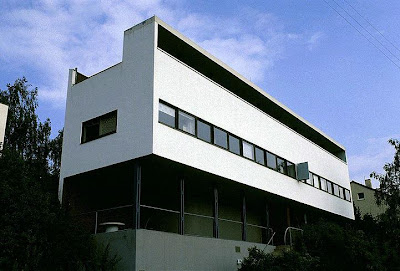
Need that flavor out of your mouth? Here's an image search of Sullivan's work. And here's some beaux arts. And what the hey - a little art nouveau and art deco. Enjoy
Subscribe to:
Posts (Atom)
